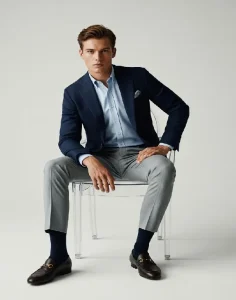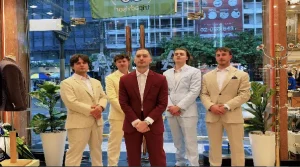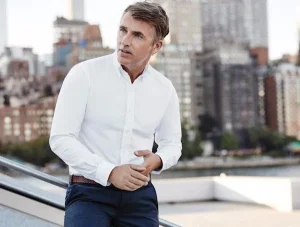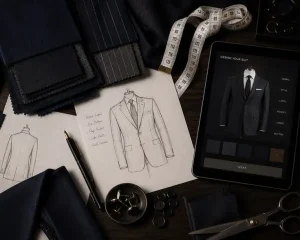
For a tall, broad-shouldered man, buying a suit off the rack is an exercise in compromise. The jacket fits across the shoulders but the sleeves are short. The trousers fit the waist but stop above the ankle. The “long” size has the right length but the wrong width, so it hangs like a borrowed coat. Bespoke tailoring removes those compromises for tall professionals in Fairfax.
None of this means your build is hard to dress. It means ready-to-wear clothing is cut for a narrower range of proportions than yours. For professionals across Fairfax and Northern Virginia who wear a suit most days, that gap shows up in every meeting.
This guide explains why standard sizing struggles with a tall, broad frame, which details matter most in a bespoke suit, and how to get one built without a local storefront.
Why Standard Sizing Struggles With a Tall, Broad Frame
Ready-to-wear suits are produced in a grid of sizes, each assuming a fixed relationship between chest, shoulders, torso length, and arm length.
A tall man with broad shoulders usually falls outside that grid in more than one direction at once. The chest may be a 44, but the shoulders and arms need to be cut for a larger frame. The “long” cut adds length to the jacket and sleeves, but it does not add width where you need it, and it rarely accounts for the proportions between your shoulders, waist, and hips.
Most people in this position end up choosing the size that fits the shoulders, since that is the hardest part to alter, and then living with whatever else is off.
Shoulders: The Part That Cannot Be Fixed Later
The shoulder is the foundation of a jacket, and it is the one area that alterations cannot rebuild.
When a jacket is too narrow across the shoulders, the fabric pulls across the back and the sleeve seam sits inside the edge of your shoulder, which creates visible strain lines. When it is too wide, the shoulder collapses over the edge and looks sloppy.
On a broad frame, the shoulder also has to match your natural slope. Broad-shouldered men often have a squarer or more athletic shoulder line, and a pattern drawn for a sloping shoulder will wrinkle at the collar and the top of the sleeve.
An individual pattern starts with your shoulders instead of adjusting around them, which removes the biggest source of fit problems before they begin.
Chest, Back, and the Drop
Broad shoulders usually come with a broad back and chest, and often a waist that is smaller in proportion.
The difference between chest and waist measurement is called the drop. Ready-to-wear suits typically use a fixed drop, often six inches. A tall, athletic build can have a larger drop, which means the jacket needs to taper more sharply from chest to waist.
If the drop is wrong, the jacket either pulls across the chest or balloons at the waist. A pattern built to your measurements lets the tailor shape the jacket to your actual taper, so it sits cleanly through the torso.
Jacket Length for Tall Frames
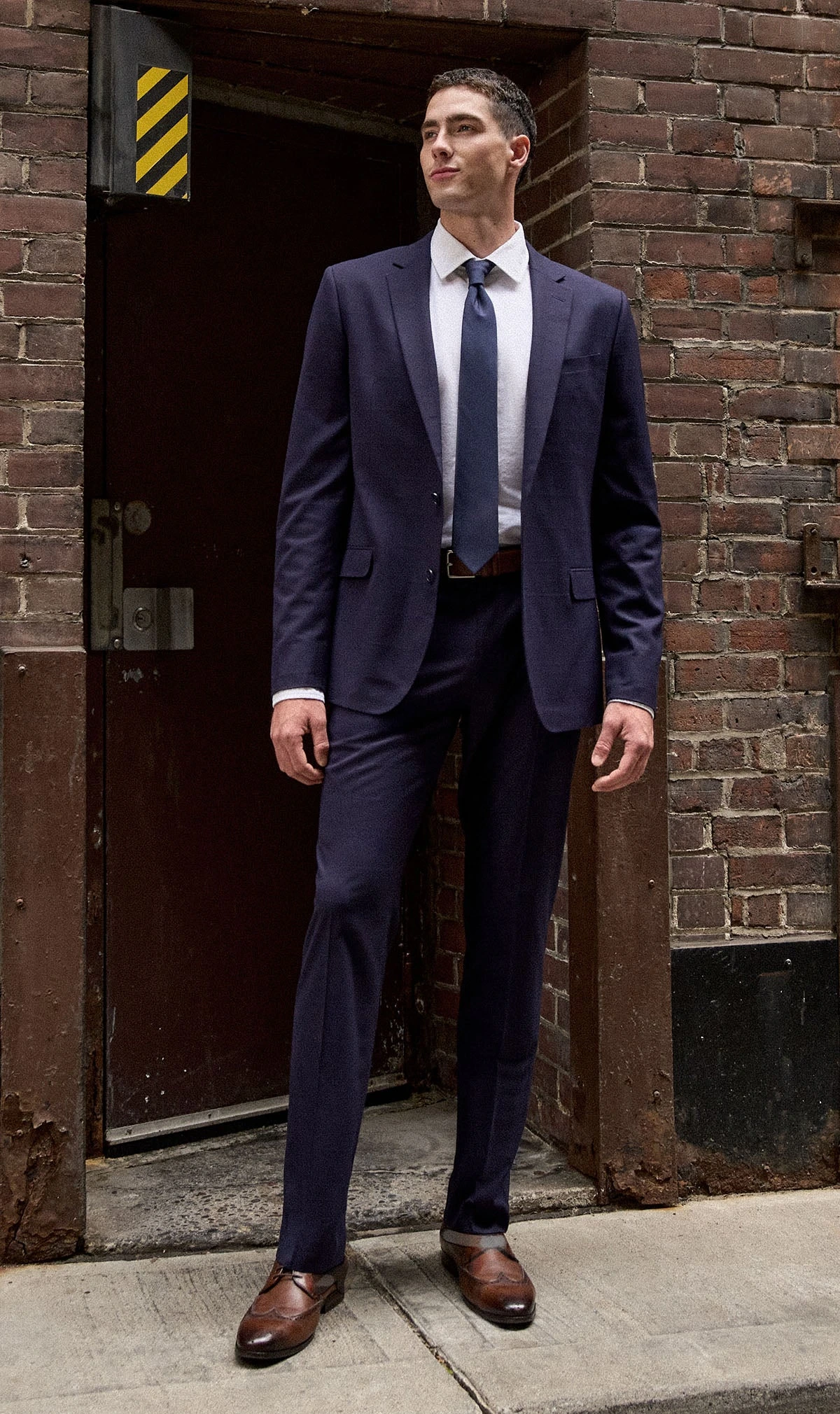
Jacket length affects the proportions of the whole outfit, and a tall man has more room to get it wrong.
A jacket that is too short makes the torso look cut off and exposes more of the trousers than intended. A jacket that is too long shortens the legs and makes the torso look heavy. A well-judged length usually covers the seat and ends around the knuckles when your arms hang naturally at your sides.
For a tall man, that means more fabric than a standard length provides, but it also means the jacket needs to be balanced against the length of the legs. A tailor can adjust the length to your build rather than defaulting to the nearest standard size.
Sleeve Length and the Cuff
Short sleeves are the most common complaint among tall men.
A jacket sleeve should end roughly where the base of your thumb meets your wrist, so that about half an inch of shirt cuff shows. On a tall man with long arms, ready-made sleeves often stop short, leaving too much cuff, or the whole wrist, exposed.
Sleeve length can sometimes be let down if there is spare fabric, but there often is not, and the sleeve pitch, which is the angle at which the sleeve hangs from the shoulder, may be wrong for your arm. Built from scratch, the sleeve is cut to your arm length and your natural posture.
Trouser Rise and Inseam
Trousers are where tall men often face the most frustration.
Standard inseams may be too short, and the rise, which is the distance from the waistband to the crotch seam, may sit too low for a long torso or too high for a long leg. Either one leads to trousers that pull when you sit or ride up when you walk.
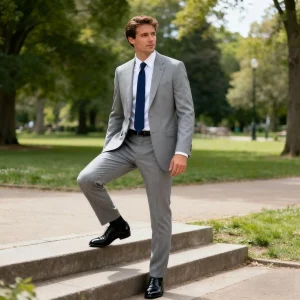
Bespoke trousers are cut to your rise and inseam individually. For a tall frame, a slightly higher rise often helps the waistband sit at the natural waist and gives the trousers a cleaner line from hip to hem. The leg length should also allow a clean break at the shoe, rather than hanging short.
Shirt Fit for a Broad, Tall Frame
The shirt under the jacket has to follow the same logic.
Broad shoulders often mean a shirt that fits the neck but pulls across the back, or fits the chest but billows at the waist. Sleeve length is a common problem too. A custom dress shirt can be cut with a wider back, longer sleeves, and a tapered body, so it sits smoothly under the jacket and keeps the cuff in the right place.

Lapel Width and Proportion
Proportion matters more on a larger frame, because small mismatches are easier to see.
A very narrow lapel can look undersized on broad shoulders, which makes the jacket seem like it belongs to a smaller man. A wider notch or peak lapel balances a broad chest and gives the jacket a more confident line. Lapel width should scale with the shoulders and the overall width of the jacket.
Button stance, which is the height at which the jacket closes, also affects how the torso reads. A slightly higher stance can help a tall man’s proportions look balanced, but the right height depends on your torso length and the jacket’s overall length. This is a detail worth discussing at the fitting.
Choosing Fabric and Pattern Scale
On a large frame, scale matters in fabric choices as well.
A tiny, tight pattern can look fussy over a wide expanse of chest and back, while a slightly larger, more open pattern tends to sit more naturally. A fine pinstripe, a medium-scale herringbone, or a soft check usually reads better on a broad frame than a very small micro-pattern.
Fabric weight is also worth thinking about. A tall, broad build carries more cloth, so a lighter weight can keep the suit comfortable through a long day, particularly in Northern Virginia’s humid summers. A heavier cloth drapes well in winter. A tailor can help you choose fabric that suits both your frame and the seasons.
Colors That Suit a Larger Frame
Color affects how much visual weight a suit carries.
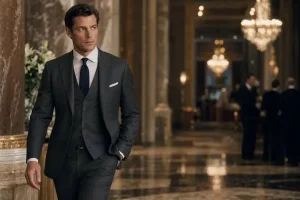
Navy and charcoal are the most versatile choices and flatter a broad frame by keeping the silhouette clean. Mid-grey works well in warmer months. Very light colors and strong contrast can draw attention to size, so they are usually best kept for accessories or occasional wear.
Solid or subtly textured cloths are a good foundation, and vertical elements such as a fine stripe can add length and balance to a broad build.
Full Canvas Construction for a Broad Frame
A broad chest and back put more strain on a jacket.
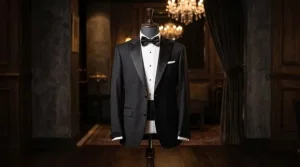
Full canvas construction uses a hand-stitched layer of natural canvas, which lets the jacket move with the body and hold its shape across the chest and lapel. When you reach, drive, or sit through a long meeting, a canvas jacket flexes where a fused jacket tends to pull and crease.
Over time, that structure also helps the jacket keep its line across a broad chest, since there is no adhesive layer that can weaken and bubble with repeated wear.
Posture, Stance, and Movement
Broad-shouldered men often have particular postures, such as squared shoulders, a forward roll, or one shoulder slightly lower than the other.
A good fitting takes your natural stance into account. The tailor observes how you stand, how you hold your arms, and how your weight sits, then adjusts the pattern so the jacket hangs cleanly in your normal posture, not in an idealized one. This is one of the main benefits of a trial fitting before the final garment is finished.
Overcoats and Outerwear
Tall, broad-shouldered men face the same problems with overcoats, often more severely.
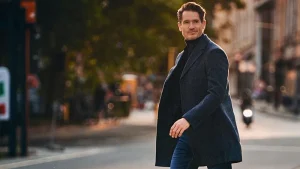
A coat has to fit over a suit jacket, which means extra room across the shoulders and chest, and enough length in the sleeves to clear the cuff. Off-the-rack coats frequently pull across the back when worn over tailoring. A coat made to fit over your suit is worth considering for Northern Virginia winters.
Getting a Bespoke Suit in Fairfax Without a Local Storefront
Genuinely bespoke tailoring is not easy to find in the immediate Fairfax area, where most options lean toward retail sizing and alterations.
Some established bespoke houses serve the region through scheduled trunk shows, taking measurements in person and building the garment at their home workshop from an individual pattern. For a professional with a demanding schedule, a small number of planned appointments often works better than repeated shop visits.
If you take this route, ask how established the visit schedule is, how many fittings are included, and whether measurements are kept on file so reorders can be handled between visits.
Bespoke Tailoring for Fairfax Professionals at AMBFA Tailor
AMBFA Tailor serves professionals across the DMV area, including Fairfax, through scheduled trunk shows in Washington D.C., bringing the same bespoke process used in our Bangkok workshop to the region.
Every suit is built from an individual pattern with full canvas construction, so shoulder width, jacket and sleeve length, and trouser rise and inseam are set around your frame, not adjusted from a standard size. Our team works with clients on proportion, fabric, and fit through the fitting process, and measurements are kept on file after your first fitting so reorders can often be handled between visits.
With more than 60 years of tailoring heritage in Bangkok, AMBFA Tailor brings that same craftsmanship to every professional we fit in the DMV area.
Frequently Asked Questions
Why do off-the-rack suits fit tall, broad-shouldered men so poorly?
Ready-to-wear suits are cut to a fixed grid of proportions. A tall, broad frame usually falls outside that grid in several ways at once, such as shoulder width, sleeve length, and torso taper, so something always fits badly.
Can alterations fix a suit that is too tight across the shoulders?
Rarely. The shoulder is the hardest part of a jacket to rebuild, so a jacket that pulls across the shoulders or back usually cannot be corrected by alteration.
What should I look for in a bespoke suit if I am tall?
Look for an individual pattern, correct sleeve and jacket length, trousers cut to your rise and inseam, and a trial fitting to check how the suit sits in your natural posture.
Can I get a bespoke suit in Fairfax without a local tailor?
Yes, through trunk show tailoring, where a bespoke house visits the DMV area on a set schedule to take measurements before building the suit at its home workshop.
A Suit Built Around Your Frame
A tall, broad-shouldered build is not a fit problem. It is a proportion that ready-to-wear sizing was never designed around. When the shoulders, sleeves, length, and trousers are all cut to your measurements, the suit sits cleanly, moves comfortably, and looks like it belongs to you.
If you are ready to have a suit built around your frame and your work in Northern Virginia, book an appointment with AMBFA Tailor and connect with our team about our next scheduled visit to the DMV area.
Book a D.C. appointment